Travel has a way of making you notice rooms. You walk into a hotel suite or a rental, and within a minute you know whether it works: where you'd drop your bag, whether two people could share it without friction, whether it feels calm. A recently profiled Mumbai apartment is a useful case study in exactly that instinct, and you can borrow its lessons for how you pick and judge places to stay.
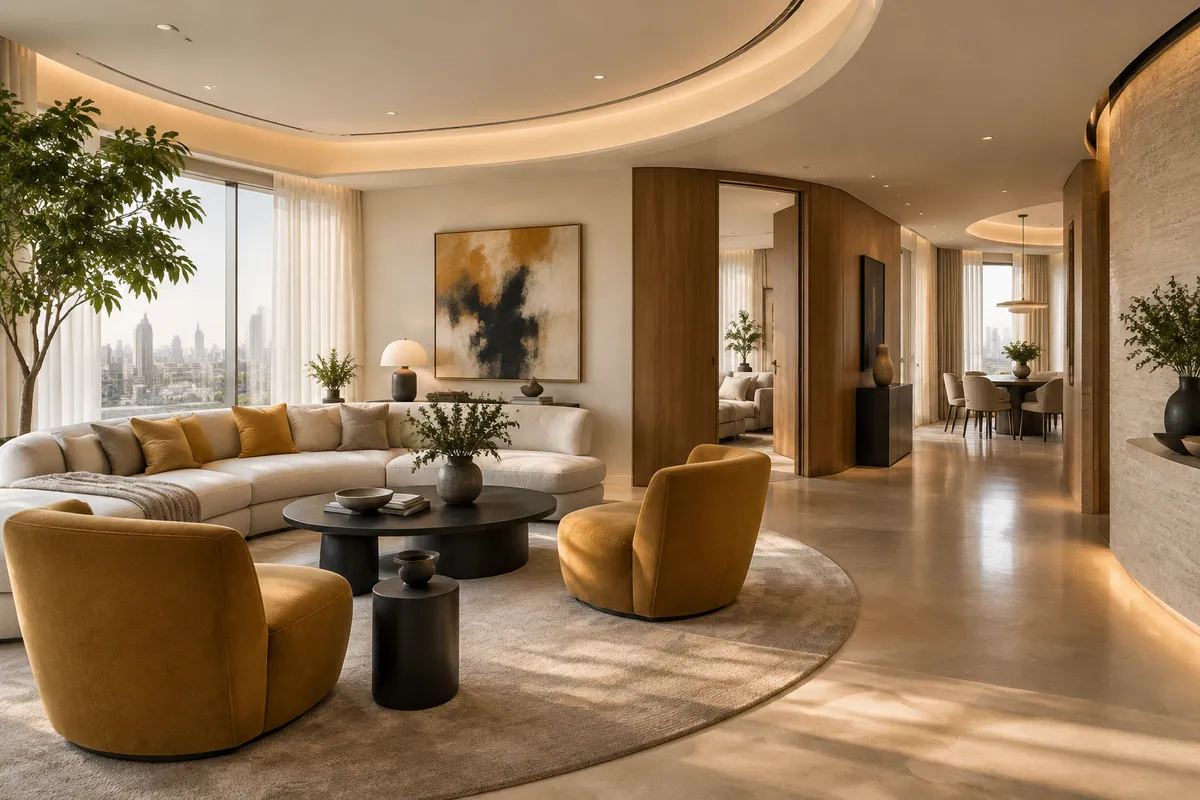
Per Architectural Digest, Studio PKA reworked a 4,000-square-foot apartment in Mumbai whose floor plan is shaped like a horseshoe. It began as a pandemic purchase, and two apartments were joined into one. The home is for a couple and their daughter, who regularly flies in from the US. The result, as the outlet describes it, is a calm, honey-toned residence.
The angle worth stealing here: a difficult layout becomes an asset when you stop fighting it.
Embrace the Curve Instead of Hiding It
A horseshoe plan could easily have been treated as a problem to straighten out. According to the report, the architects went the other way and embraced the curve, shaping the home into a cohesive whole rather than a string of awkward leftovers.
What this means when you travel: An oddly shaped room or suite isn't automatically a red flag. Ask whether the layout feels intentional. A curved corridor, a room that wraps around a view, or an unusual footprint can feel more special than a standard box, as long as the furniture and flow respect the shape.
Plan Privacy for More Than One Generation
The home serves parents and an adult daughter who visits from abroad. Per the profile, the architects planned privacy for two generations. That's a design brief many families recognize, especially anyone who has traveled with grown-up kids or parents.
A horseshoe shape lends itself to this, since a plan that bends around can naturally separate zones. That's our observation rather than a claim from the report, but it's a handy way to read any floor plan.
How to apply it on your next trip
- Check the bedroom separation. When booking a rental for multiple generations, look at the floor plan or photos. Are bedrooms clustered together, or can people get real distance?
- Look for a shared space that isn't a bedroom. A living area gives everyone a place to gather without crowding.
- Ask about bathrooms. Privacy falls apart quickly when everyone queues for one.
One Design Language Makes Big Spaces Feel Calm
Joining two apartments could produce a home that feels like two stitched-together halves. Instead, Studio PKA reportedly curated every object, artwork and finish from scratch, treating the interiors as part of the architecture rather than an afterthought. The outcome, per Architectural Digest, is a honey-toned, cohesive feel.
You can spot this quality anywhere. In a hotel or rental listing, scan the photos for repetition: a consistent palette, materials that echo each other, art that feels chosen rather than bought in bulk. Places with a single design language usually feel calmer, and calm is often what you're paying for when you travel.
A quick photo-scan test
- Pick out the two or three dominant colors or materials in the images.
- See whether they appear in every room, not just the lobby or living area.
- Check whether the details (lighting, art, textiles) look considered or random.
If the answer is yes across the board, the space was likely designed as a whole.
The Horseshoe as Symbol
The home's shape carries a bit of meaning too. The horseshoe is widely seen as a good-luck symbol, and the profile leans into that idea of a home with emotional resonance. It's a reminder that the places we love, at home or away, often have a story attached.
When you're choosing where to stay, that story matters. A property with a clear idea behind it, whether a shape, a local craft tradition or a family history, tends to feel more memorable than one that is merely nice.
Why a Home Built for Visitors Is a Good Travel Model
One detail stands out for travelers: the daughter flies in regularly from the US. This is a home that has to work both for people who live there every day and for someone who arrives, unpacks and settles in for a stretch. That dual purpose is what good hospitality looks like too.
The next time you evaluate a stay, ask the same questions the architects had to answer:
- Can a visitor feel at home quickly?
- Is there privacy when you want it and togetherness when you don't?
- Does the whole place feel like one idea?
Mumbai as a Design Stop
If this profile has you curious about Mumbai's interiors, it's a good prompt to build design into your itinerary. Look for architecture studios' public projects, boutique hotels with strong design identities and shops where craft and contemporary style meet. The Studio PKA home is private, so you won't be visiting it, but it shows the kind of thoughtful, personalized planning you can look for in the city's stays and spaces.
The Takeaway
Before you book your next stay, spend two minutes with the floor plan and photos. Look for a layout that makes sense for your group, privacy where you need it, and one consistent design idea running through every room. An unusual shape isn't a drawback if someone has clearly designed around it.